
做 A/B 测试或者分析转化率的时候,经常会碰到那个老生常谈的问题:
“这数据的波动到底是干预引起的,还是仅仅是相关性?”
传统的分析手段和机器学习擅长告诉你什么能预测结果,但预测不等于因果。而在做决策,不管是干预、优化还是调整业务逻辑时,我们需要的是因果关系。
今天介绍一下 PyCausalSim,这是一个利用模拟方法来挖掘和验证数据中因果关系的 Python 框架。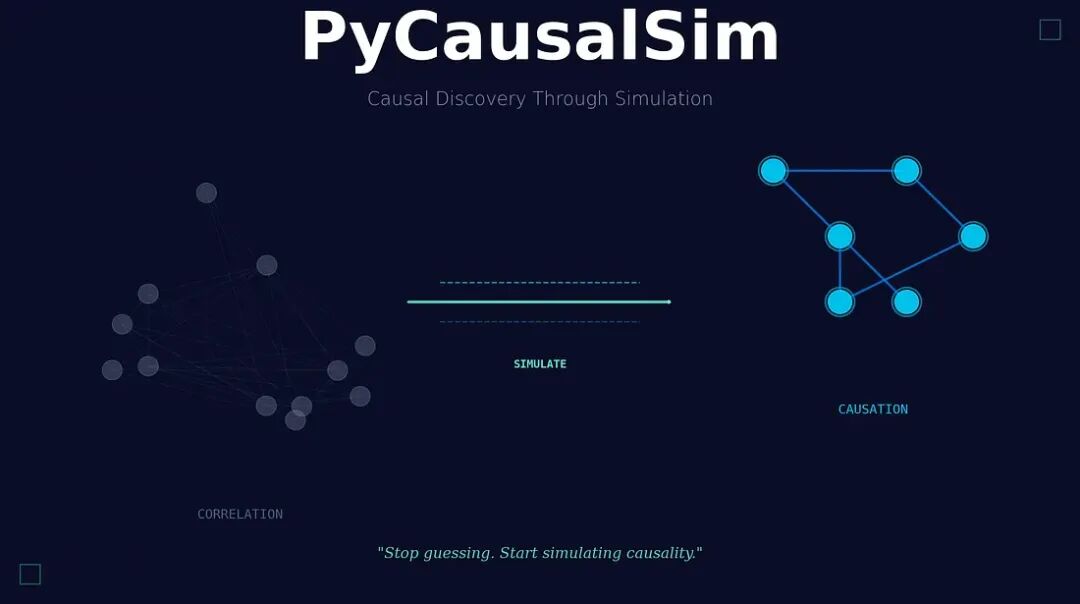
问题:相关性好找,因果难定
举个例子,减少页面加载时间后转化率涨了,看起来是没问题的。但这真的是加载速度的功劳吗?也许同期正好上了新的营销活动,或者是季节性效应,甚至仅仅是竞争对手挂了,又或者只是随机噪声。这时候传统方法往往会失效:
 # WRONG: This doesn't tell you what CAUSES conversions
 from sklearn.ensemble import RandomForestRegressor

 rf = RandomForestRegressor()
 rf.fit(X, y)
 print(rf.feature_importances_)  # Tells you what predicts, NOT what causes
Feature importance 只能告诉你什么能预测结果,它搞不定混淆变量(confounders),分不清因果方向,在遇到选择偏差(selection bias)时也会翻车,因为它给出的仅仅是相关性。
PyCausalSim
PyCausalSim 走的是另一条路。它不光是找数据模式,而是:学习系统的因果结构,模拟反事实场景(Counterfactuals,即“如果……会发生什么”),然后通过严格的统计检验验证因果假设。他的工作流程大致如下:
 from pycausalsim import CausalSimulator

 # Initialize with your data
 simulator = CausalSimulator(
     data=df,
     target='conversion_rate',
     treatment_vars=['page_load_time', 'price', 'design_variant'],
     confounders=['traffic_source', 'device_type']
 )

 # Discover causal structure
 simulator.discover_graph(method='ges')

 # Simulate: What if we reduce load time to 2 seconds?
 effect = simulator.simulate_intervention('page_load_time', 2.0)
 print(effect.summary())
输出
  Causal Effect Summary
 ==================================================
 Intervention: page_load_time = 2.0
 Original value: 3.71
 Target variable: conversion_rate

 Effect on conversion_rate: +2.3%
 95% CI: [+1.8%, +2.8%]
 P-value: 0.001
这是真正的因果效应估计,不再是简单的相关性分析。
核心因果模拟器 (Core Causal Simulator)
CausalSimulator
类是整个框架的核心。它负责图发现(从数据中自动学习因果结构)、干预模拟(蒙特卡洛模拟反事实结果)、驱动因素排序、策略优化以及内置的验证模块(敏感性分析、安慰剂检验等)。
 # Rank true causal drivers
 drivers = simulator.rank_drivers()
 for var, effect in drivers:
     print(f"{var}: {effect:+.3f}")

 # Output:
 # page_load_time: +0.150
 # price: -0.120
 # design_variant: +0.030
营销归因 (Marketing Attribution)
别再只看 Last-touch 归因了,了解每个渠道的真实增量价值才是最重要的:
 from pycausalsim import MarketingAttribution

 attr = MarketingAttribution(
     data=touchpoint_data,
     conversion_col='converted',
     touchpoint_cols=['email', 'display', 'search', 'social', 'direct']
 )

 # Causal Shapley values for fair attribution
 attr.fit(method='shapley')
 weights = attr.get_attribution()
 # {'search': 0.35, 'email': 0.25, 'social': 0.20, 'display': 0.15, 'direct': 0.05}

 # Optimize budget allocation
 optimal = attr.optimize_budget(total_budget=100000)
支持的方法包括 Shapley 值(博弈论)、马尔可夫链归因、Uplift 归因、逻辑回归以及传统的首末次接触基线。
A/B 测试分析 (A/B Test Analysis)
实验分析不能只靠 t-test,引入因果推断能做得更深:
 from pycausalsim import ExperimentAnalysis

 exp = ExperimentAnalysis(
     data=ab_test_data,
     treatment='new_feature',
     outcome='engagement',
     covariates=['user_tenure', 'activity_level']
 )

 # Doubly robust estimation (consistent if EITHER model is correct)
 effect = exp.estimate_effect(method='dr')
 print(f"Effect: {effect.estimate:.4f} (p={effect.p_value:.4f})")

 # Analyze heterogeneous effects
 het = exp.analyze_heterogeneity(covariates=['user_tenure'])
 # Who responds differently to the treatment?
支持简单均值差分、OLS 协变量调整、IPW(逆概率加权)、双重稳健(Doubly Robust / AIPW)以及倾向性评分匹配。
Uplift 建模
关注点在于谁会对干预产生反应,而不只是平均效应。
 from pycausalsim.uplift import UpliftModeler

 uplift = UpliftModeler(
     data=campaign_data,
     treatment='received_offer',
     outcome='purchased',
     features=['recency', 'frequency', 'monetary']
 )

 uplift.fit(method='two_model')

 # Segment users by predicted response
 segments = uplift.segment_by_effect()
用户分层非常直观:
- Persuadables — 只有被干预才转化。这是核心目标。
- Sure Things — 不干预也会转化。别在这浪费预算。
- Lost Causes — 干预了也没用。
- Sleeping Dogs — 干预反而起反作用。绝对要避开。
结构因果模型 (Structural Causal Models)
如果你对系统机制有明确的先验知识,还可以构建显式的因果模型:
 from pycausalsim.models import StructuralCausalModel

 # Define causal graph
 graph = {
     'revenue': ['demand', 'price'],
     'demand': ['price', 'advertising'],
     'price': [],
     'advertising': []
 }

 scm = StructuralCausalModel(graph=graph)
 scm.fit(data)

 # Generate counterfactuals
 cf = scm.counterfactual(
     intervention={'advertising': 80},
     data=current_data
 )

 # Compute average treatment effect
 ate = scm.ate(
     treatment='price',
     outcome='revenue',
     treatment_value=27,
     control_value=30
 )
多种发现算法
PyCausalSim 集成了多种算法来学习因果结构,适应不同场景:
- PC (Constraint-based) — 通用,可解释性强。
- GES (Score-based) — 搜索效率高,默认效果不错。
- LiNGAM (Functional) — 处理非高斯数据效果好。
- NOTEARS (Neural) — 神经网络方法,能处理复杂关系。
- Hybrid (Ensemble) — 通过多种方法的共识来提高稳健性。
 # Try different methods
 simulator.discover_graph(method='pc')      # Constraint-based
 simulator.discover_graph(method='ges')     # Score-based
 simulator.discover_graph(method='notears') # Neural
 simulator.discover_graph(method='hybrid')  # Ensemble
内置验证
任何因果结论都得经得起推敲。PyCausalSim 内置了验证模块:
 sensitivity = simulator.validate(variable='page_load_time')

 print(sensitivity.summary())
 # - Confounding bounds at different strengths
 # - Placebo test results
 # - Refutation test results
 # - Robustness value (how much confounding would nullify the effect?)
安装
直接从 GitHub 安装:
pip install git+[https://github.com/Bodhi8/pycausalsim.git](https://github.com/Bodhi8/pycausalsim.git)
或者 clone 到本地:
 git clone [https://github.com/Bodhi8/pycausalsim.git](https://github.com/Bodhi8/pycausalsim.git)
 cd pycausalsim
 pip install -e".[dev]"
依赖库包括 numpy, pandas, scipy, scikit-learn (核心),可视化用到 matplotlib 和 networkx。也可选集成 dowhy 和 econml。
总结
PyCausalSim 的构建基于数十年的因果推断研究成果:Pearl 的因果框架(结构因果模型、do-calculus)、Rubin 的潜在结果模型,以及现代机器学习方法(NOTEARS, DAG-GNN)和蒙特卡洛模拟。并且它与 DoWhy (Microsoft), EconML (Microsoft) 和 CausalML (Uber) 等生态系统兼容。
机器学习问“会发生什么”,因果推断问“为什么发生”,而PyCausalSim解决的是“如果……会发生什么”。
地址:
https://github.com/Bodhi8/pycausalsim
作者:Brian Curry